
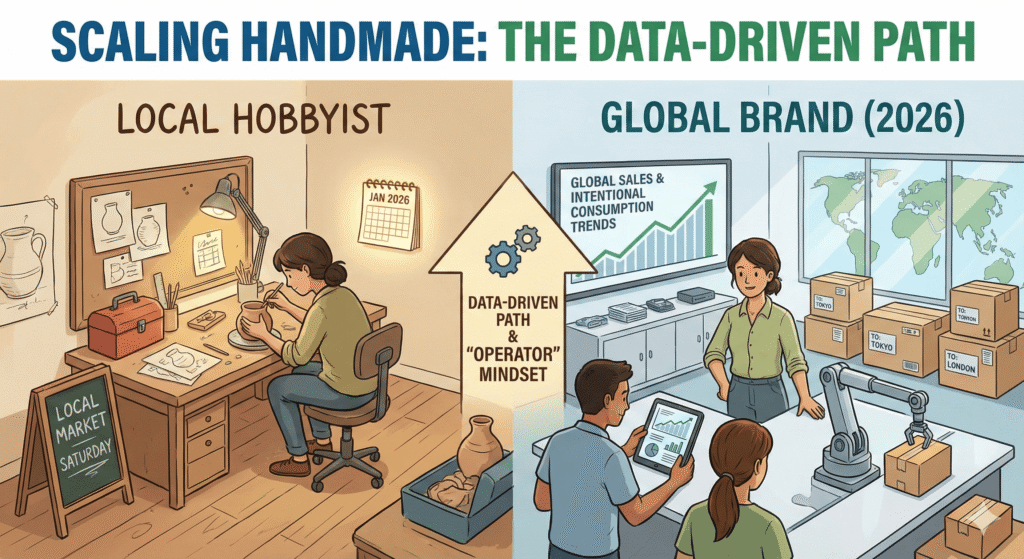
Transitioning a handmade business from a weekend hobby to a legitimate global brand requires more than just talent. It requires a shift in mindset from ‘maker’ to ‘operator.’ As we look at the landscape for 2026, the data shows a significant shift in consumer behavior toward what economists call ‘intentional consumption.’ People aren’t just buying products; they are investing in the provenance and the process. To scale effectively, you need to understand the technical and logistical frameworks that support this growth.
Understanding the 2026 Market Landscape
The global handicrafts market is no longer a niche segment. Recent projections indicate a compound annual growth rate (CAGR) that continues to outpace traditional retail. This growth is fueled by a demographic shift where Gen Z and Millennial buyers prioritize sustainability and authenticity over price and convenience.
Data suggests that 62% of consumers are willing to pay a premium for items with a documented story. For a handmade seller, this means your ‘About’ page and product descriptions are as much a part of your inventory as the physical goods. However, scaling this ‘story’ globally introduces complexities in digital infrastructure and supply chain management that many artisans aren’t prepared for.
The Shift Toward Slow Commerce
Slow commerce is the antithesis of the ‘fast fashion’ model. It focuses on quality, longevity, and ethical production. In 2026, successful brands are those that lean into this by providing transparency in their sourcing. If you’re scaling, you need to move beyond local craft fairs and look at how your digital presence communicates these values to someone 5,000 miles away.
Building a Technical Foundation That Scales
One of the biggest hurdles for artisans is the ‘technical tax’—the cost and complexity of setting up a professional storefront. In the past, you either paid high monthly fees or needed a degree in computer science to get a site running. Today, the barrier to entry has dropped, but the requirements for security and performance have increased.
- Zero-Cost Entry Points: Utilizing platforms that allow you to launch for free is a strategic move for testing new markets without risking capital.
- Mobile-First Architecture: Over 75% of global e-commerce transactions now happen on mobile devices. Your store must be responsive and fast.
- Integrated Analytics: You cannot manage what you do not measure. Real-time data on visitor behavior, conversion rates, and cart abandonment is non-negotiable.
Security as a Brand Pillar
As a small brand, trust is your most valuable currency. A single security breach can end a business before it starts. Implementing high-level encryption and secure payment gateways isn’t just a technical requirement; it’s a customer service standard. When a buyer in another country sees a secure checkout, it bridges the gap between ‘stranger’ and ‘trusted brand.’
Operational Efficiency: Beyond the Craft
Scaling means you’ll eventually spend less time making and more time managing. This is the ‘Artisan’s Paradox.’ To grow, you must automate the repetitive tasks that don’t require your creative input. This includes order tracking, inventory synchronization, and automated customer notifications.
Inventory Management for Makers
Handmade items often have unique SKU challenges. If you sell a one-of-a-kind piece on your website, it needs to be reflected across all your sales channels instantly. Overselling is a quick way to damage your reputation. Use a centralized dashboard to keep your stock levels accurate in real-time. This prevents the logistical nightmare of having to issue refunds and apologize to disappointed customers.
Navigating International Waters
Going global sounds intimidating, but the world is smaller than it used to be. The key is to simplify the complexity for the customer. They shouldn’t have to worry about currency conversion or international shipping rates; your platform should handle that automatically.
- Localization: Display prices in the local currency of the visitor.
- Transparent Shipping: Use integrated shipping calculators to provide accurate costs at checkout.
- Duty and Tax Compliance: Stay informed about international trade regulations to avoid packages getting stuck in customs.
Key Takeaways for 2026 Success
Scaling a handmade business is a marathon, not a sprint. The brands that will dominate in 2026 are those that combine the soul of an artisan with the precision of a data scientist. Focus on building a secure, user-friendly foundation that allows you to test, learn, and pivot without heavy financial overhead.
Start by auditing your current workflow. Identify where you are losing time on manual tasks and look for tools that can automate those processes. By freeing up your creative energy, you can focus on what actually grows the brand: creating exceptional products and telling a story that resonates globally. The tools to build a world-class brand are now accessible to everyone—the only variable left is your strategy.
Interested in launching an online store for free? E2C Store might be the perfect fit for you.
Read about “Scaling Your Handmade Business in 2026: A Data-Driven Framework for Global Growth” next.

Leave a Reply