
When you start selling online, the first few sales feel like a massive win. But then you look at your payout and realize a significant chunk of that money never actually hit your bank account. If you’re selling on a marketplace like eBay, you’re likely paying for the privilege of their traffic through “Final Value Fees.” While these platforms offer a massive audience, the cost of doing business there has been steadily climbing.
In early 2025, eBay adjusted fees across most categories, with some seeing increases of up to 0.35%. For most sellers, this means losing between 12% and 15% of every single sale—and that’s before you even consider shipping costs or the fixed per-order fees. If you’re trying to scale a small business, those margins can be the difference between growing and just breaking even.
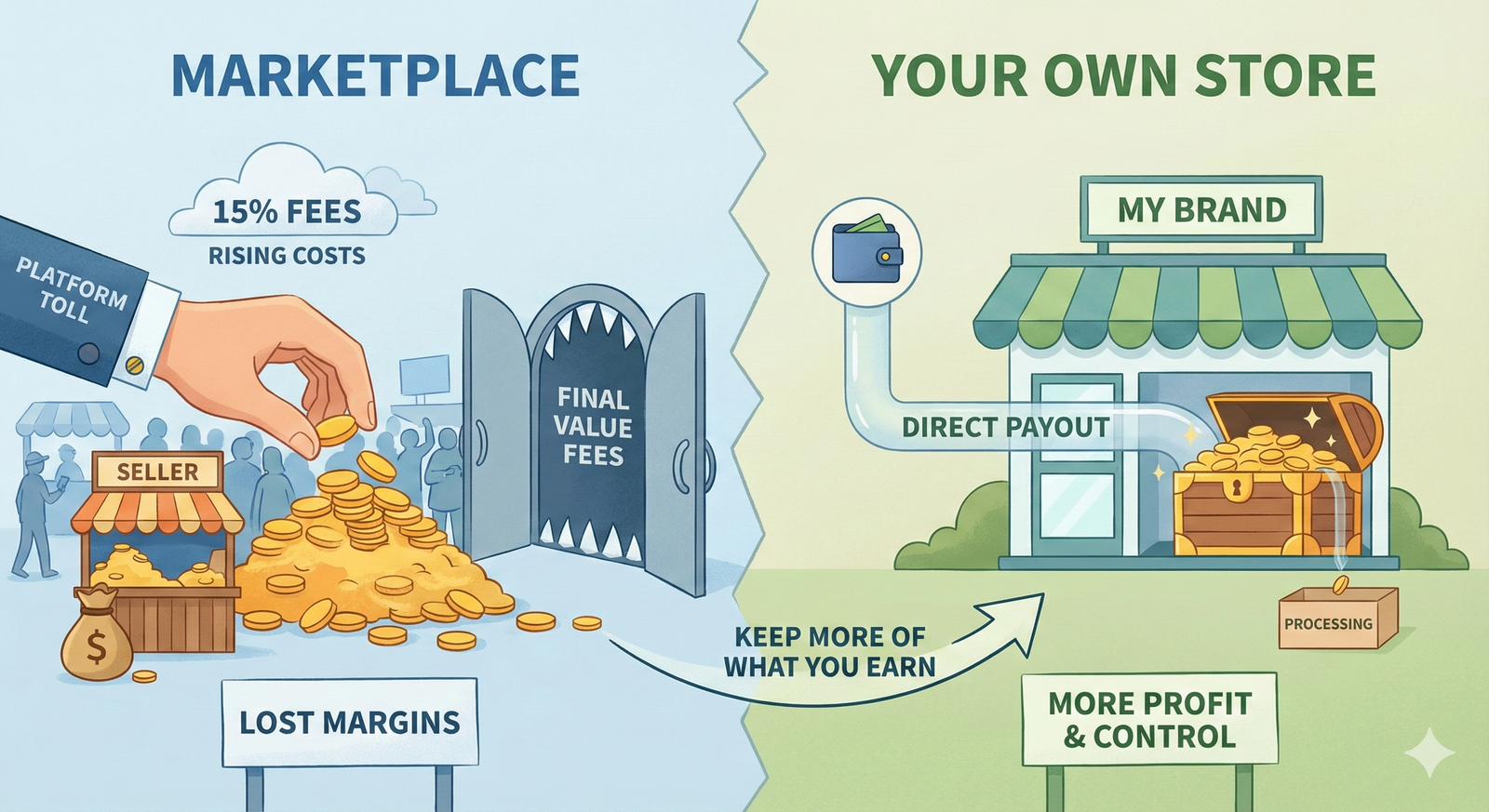
Breaking Down the eBay Fee Structure
To understand where your money is going, we have to look at the total transaction. eBay doesn’t just take a cut of the item price; they take a percentage of the total sale amount. This includes the item price, the shipping charges you collect, and even the sales tax.
For a standard category with a 13.25% fee, a $100 sale (including shipping) immediately loses $13.25 to the platform. Add in the $0.30 to $0.40 per-order fee, and you’re looking at nearly 14% gone before you’ve even accounted for your product cost or packaging.
Key eBay Data Points:
- Final Value Fees: Typically 12% to 15%.
- Per-Order Fee: $0.30 to $0.40.
- Managed Payments: While this covers processing, the high percentage is the trade-off for eBay’s built-in buyer traffic.
The E2C Store Alternative: Prioritizing Your Margins
At E2C, we take a different approach. We aren’t a marketplace where buyers search for generic terms; we’re an e-commerce enabler. This means we provide the tools for you to run your own branded store, and because we don’t have the overhead of a massive search engine, we can keep our fees significantly lower.
E2C charges a flat 1.99% transaction fee.
Now, to be completely transparent—and this is important for your bookkeeping—you also have to account for payment processing. Since you’re running your own store, you’ll use a provider like Stripe or PayPal. They typically charge about 2.9% + $0.30.
When you add it all up, your total effective cost on E2C is roughly 4.89% + $0.30. Compare that to eBay’s ~13-15%, and you’re keeping nearly 10% more of your revenue on every single order.
Traffic vs. Profit: The Strategic Trade-off
It’s important to understand why this price gap exists. When you sell on eBay, you’re paying for discovery. You’re paying for access to their 130 million active buyers. If you have a one-off item or something very niche, that traffic is valuable.
However, if you’re building a brand, eBay can feel like a treadmill. You’re constantly competing on price, and you don’t truly “own” the customer relationship.
E2C is designed for the seller who wants to build something lasting. You use your social media, email lists, or SEO to drive traffic to a site that is uniquely yours. You aren’t just a line item in a search result; you’re a destination. The lower fee structure reflects this partnership—we provide the secure, reliable infrastructure, and you keep the lion’s share of the profit because you’re the one building the brand.
Why Successful Sellers Use a Hybrid Model
Many of the most successful entrepreneurs we work with don’t actually choose one or the other—they use both strategically. This is often called a “hybrid” approach.
They use eBay as a customer acquisition tool. They list a few items there to catch the eye of new buyers. But once that customer is in their ecosystem, they move them to their E2C store for repeat purchases.
This strategy allows you to:
- Use eBay’s massive reach to find new people.
- Use E2C’s low fees to maximize profit on loyal customers.
- Build an email list and brand identity that you actually control.
Key Takeaways for Your Business
If you’re feeling the squeeze from marketplace fees, it’s time to run the numbers on your own sales data. A 10% difference in fees might not seem like much on a single $20 item, but as you scale to $1,000 or $10,000 in monthly sales, that’s thousands of dollars staying in your pocket instead of going to a corporate marketplace.
Building your own store on E2C is about more than just saving money; it’s about taking ownership of your business growth. When you’re ready to stop paying the “discovery tax” on every single repeat order, we’re here to help you make the transition simple, secure, and free.
Read about how E2C Store compares with Etsy.

Leave a Reply