
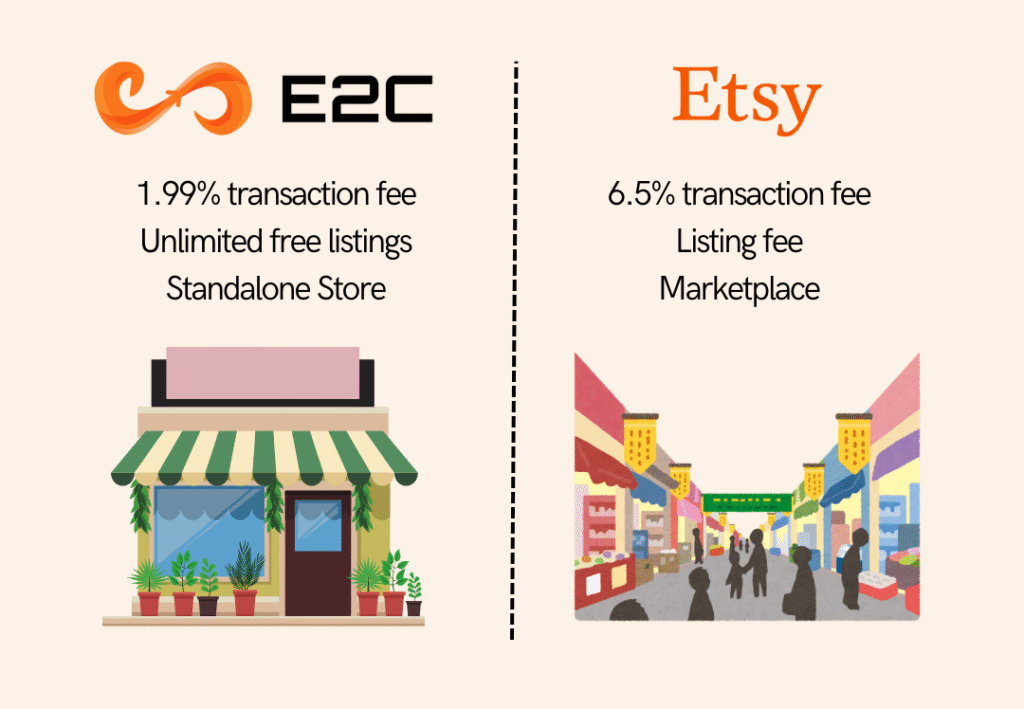
For artists, makers, and vintage curators, the dream is simple: spend more time creating and less time managing a website. For years, Etsy has been the default starting point for creative entrepreneurs. However, as the marketplace becomes more crowded and fees continue to rise, many are looking for a more cost-effective, brand-focused alternative.
Enter E2C Store. While Etsy offers a massive marketplace of ready-to-buy shoppers, E2C Store offers a streamlined, “fee-friendly” way to own your brand without the marketplace noise.
This E2C vs Etsy comparison will break down the real-world costs and features of both platforms to help you decide where your products—and your profits—belong in 2026.
Quick Overview
E2C Store: The Brand-Builder’s Alternative
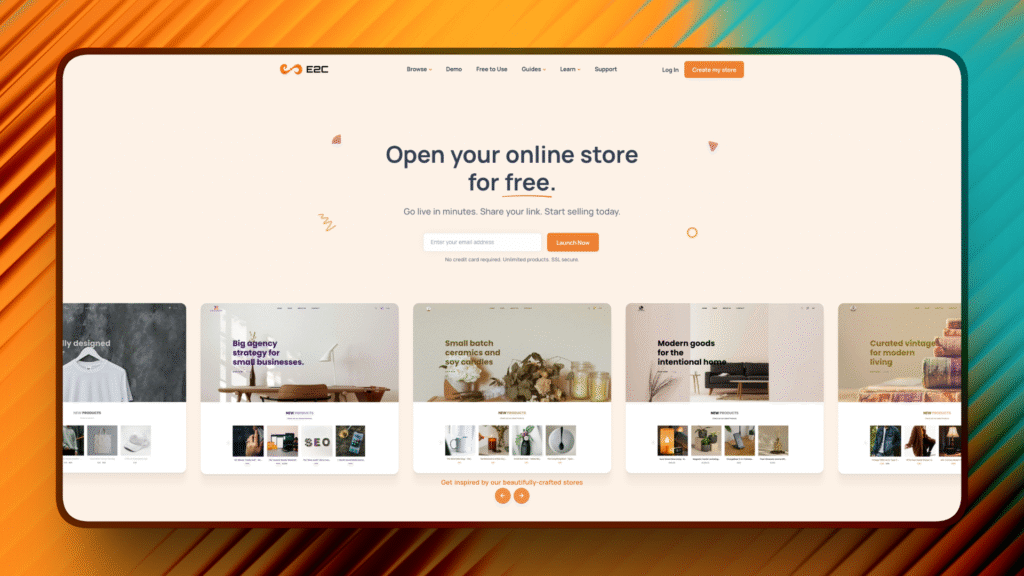
E2C Store is designed for creators who want a professional, standalone storefront without the monthly subscription costs of Shopify or the high commission rates of Etsy. It provides a prebuilt, customizable website with a unique URL (e2c.store/your-store), unlimited product listings, and an intuitive dashboard for orders and analytics.
The platform’s standout feature is its pricing: $0 per month and a simple 1.99% transaction fee. This makes it ideal for creators who drive their own traffic through Instagram, TikTok, or word-of-mouth and want to keep more of every dollar they earn.
Etsy: The Global Marketplace
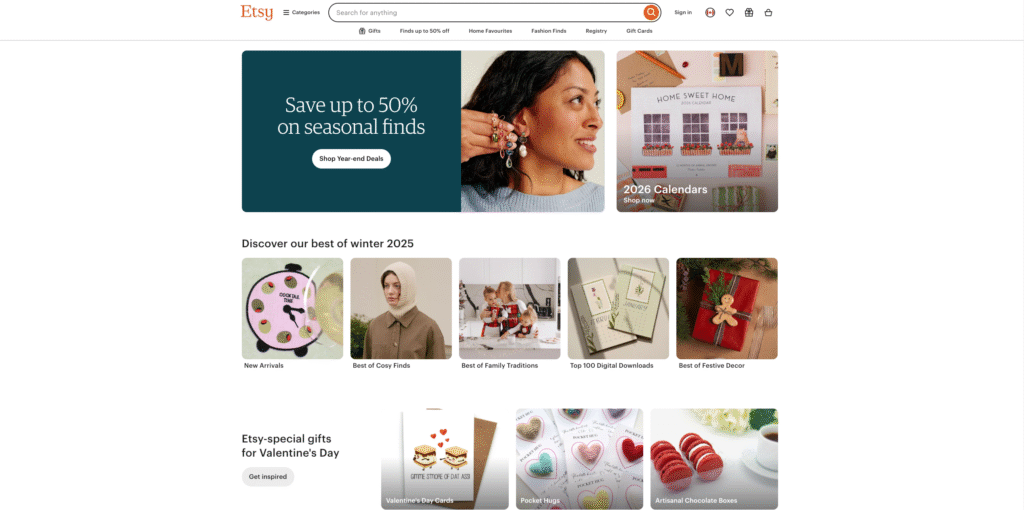
Etsy is a powerhouse marketplace with millions of active buyers specifically looking for handmade and vintage goods. It eliminates the need for marketing from scratch by placing your products in front of a built-in audience.
However, selling on Etsy is no longer “free to start.” Most new shops now face a $15 one-time setup fee, and every single item you list costs $0.20, whether it sells or not.
E2C vs Etsy Head-to-Head Comparison
| Feature | E2C Store | Etsy |
| Monthly Subscription | $0 | $0 (Standard) or $10 (Plus) |
| One-Time Setup Fee | $0 | ~$15 (for most new shops) |
| Listing Fee | $0 (Unlimited) | $0.20 per item (expires every 4 months) |
| Transaction Fee | 1.99% | 6.5% |
| Payment Processing | ~2.9% + 30¢ (Stripe/PayPal) | 3% + $0.25 (US) |
| Marketplace Traffic | No (Drive your own) | Yes (Built-in discovery) |
| Custom Branding | Standalone storefront feel | Marketplace “booth” feel |
| Offsite Ads Fee | None | 12%–15% (only if you run ads) |
| Ownership of Data | You own customer emails | Limited access to customer data |
| * data as of Dec 29, 2025 |
The “Fee Stack”: Why Profit Margins Matter
The biggest difference between these platforms is how they impact your bottom line.
The Etsy “Fee Stack”
When you sell a $50 item on Etsy, the fees pile up quickly:
- Listing Fee: $0.20
- Transaction Fee (6.5%): $3.25
- Payment Processing (3% + $0.25): $1.75
- Total Fees: $5.20 (10.4%)
- Note: If the sale comes from an Offsite Ad, Etsy takes an additional 12-15%, which could push your total fees to over 20%.
The E2C Store “Fee Stack”
For that same $50 item on E2C Store:
- Listing Fee: $0.00
- Platform Fee (1.99%): $0.99
- Payment Processing (~2.9% + 30¢): $1.75
- Total Fees: $2.74 (5.5%)
By choosing E2C Store, you keep roughly double the profit on every sale compared to a standard Etsy transaction.
Where Etsy Falls Short
1. High Competition and “The Scroll”
On Etsy, your competitors are literally one scroll away. When a customer views your listing, Etsy often displays “Similar Items” or “You may also like” at the bottom of the page, leading buyers away from your shop and toward a competitor.
2. Branding Limitations
On Etsy, you don’t really own a “website”—you own a “shop” within someone else’s mall. You are limited to a banner and a logo. E2C Store provides a dedicated storefront where the customer is focused entirely on your brand and your story.
3. Fee Anxiety
Etsy’s $0.20 listing fee applies every four months and every time an item sells. For artists with large catalogs or low-priced items (like stickers or digital prints), these micro-fees create constant overhead, even during slow months. E2C Store’s $0 listing model eliminates this pressure.
Where Etsy Wins
1. Instant Discovery
The primary reason to stay on Etsy is its search engine. If you have no social media following and no marketing budget, Etsy’s built-in traffic is a massive advantage. Buyers go to Etsy with their wallets out, ready to search for “Handmade Ceramic Mug.”
2. Built-in Trust
Etsy is a globally recognized brand. New customers who might be wary of a standalone website often feel more secure buying through Etsy’s established checkout and protection programs.
Who Should Choose What?
Choose E2C Store If:
- You have a social media following: If you’re already driving traffic from Instagram, TikTok, or a newsletter, don’t pay Etsy a 6.5% “finder’s fee” for customers you found yourself.
- You want to maximize margins: You want the lowest possible fees so you can keep your prices competitive.
- You want a professional brand: You want a clean, dedicated URL and a storefront that feels like a real business, not a hobby.
- You sell high-volume or low-cost items: No listing fees mean you can list 500 different sticker designs without paying a cent until they sell.
Choose Etsy If:
- You have zero audience: You need Etsy’s search engine to help people find you.
- You sell very niche “searchable” items: Your products are something people specifically search for (e.g., “1970s vintage flared jeans”).
- You are a casual hobbyist: You only sell a few items a year and don’t mind the high fees in exchange for the convenience of a marketplace.
Verdict
In 2026, the most successful creators are using a hybrid approach. They use Etsy as a “discovery lab” to see which products people search for, but they drive their loyal fans and social media followers to their own E2C Store.
If you are tired of watching Etsy eat 15–20% of your revenue through a “stack” of listing, transaction, and ad fees, E2C Store is the most logical next step. It gives you the professional independence of a standalone store with the financial freedom of a $0 monthly subscription.
The choice is simple: Use Etsy to be found, but use E2C Store to build your business.

Leave a Reply