
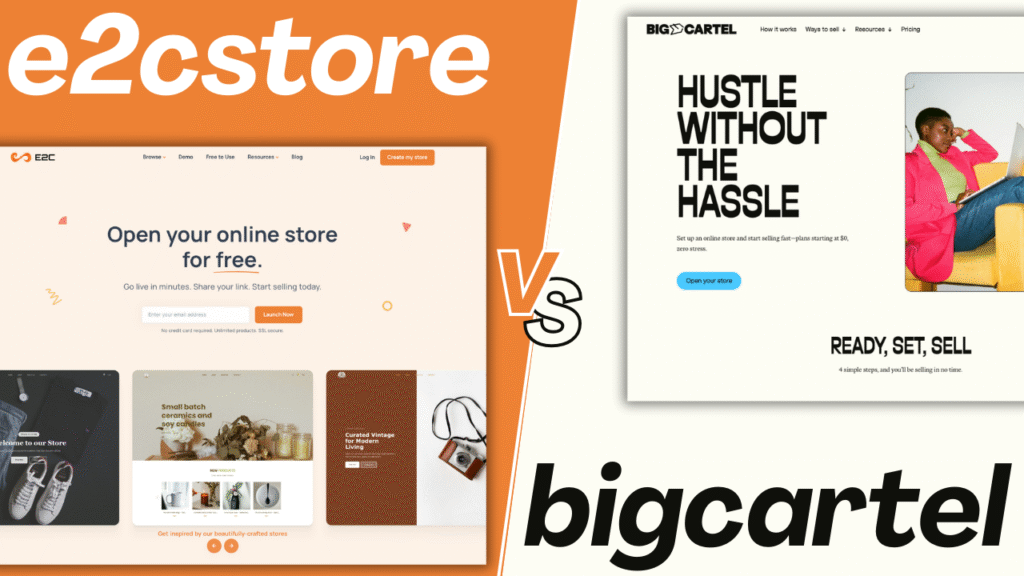
Starting a small business often feels like a balancing act between keeping costs low and finding room to grow. For many artists and makers, the first choice is usually a platform that offers a free entry point. However, not all free plans are built the same way. When we look at the data behind Big Cartel and E2C Store, the differences in how they handle product limits and monthly overhead become clear very quickly.
The Reality of Product Caps
Most platforms use product limits as a way to nudge users toward a paid subscription. In the case of Big Cartel, their free tier—known as the Gold plan—is strictly limited to 5 products. While this works for a creator with a very small, static inventory, it often becomes a bottleneck for anyone looking to test new ideas or offer variations.
If you have six items, you’re immediately pushed into a paid tier. This creates a “pay-to-play” environment where your monthly expenses start before you’ve necessarily found your footing in the market. For a side hustler, that $9.99 monthly fee is a fixed cost that exists whether you make a sale or not.
Breaking Down Big Cartel’s Tiered Pricing
Big Cartel has been a staple for the creative community for years, but its structure is built on rigid tiers. To move beyond those first five items, you have to commit to a monthly subscription:
- Platinum Plan: $9.99/month for up to 50 products.
- Diamond Plan: $19.99/month for up to 500 products.
One significant data point to consider is the hard cap of 500 products. Even at their highest paid level, Big Cartel limits your catalog size. For businesses that rely on high-volume inventory or frequently rotating collections, this ceiling can eventually force a platform migration, which is often a time-consuming and technical process.
E2C Store: A Different Approach to Scalability
E2C Store operates on a fundamentally different revenue model designed for accessibility. Instead of charging a monthly subscription fee to unlock more listings, the platform offers unlimited product listings for $0/month.
This shift removes the financial risk of expanding your catalog. Whether you have 5 products or 500, your fixed monthly overhead remains at zero. This is particularly beneficial for sellers with diverse inventories or those who want to list variations (like different sizes or colors) without worrying about hitting a limit.
The Math Behind the Transaction Fee
To keep the platform free of monthly costs, E2C utilizes a 1.99% transaction fee on sales. It’s important to look at this through a data-driven lens.
If you’re a small seller with 15 products making $100 in sales a month, your costs would look like this:
- Big Cartel: $9.99 (Platinum Plan fee)
- E2C Store: $1.99 (1.99% transaction fee)
In this scenario, E2C is significantly more cost-effective. The “pay-as-you-grow” model ensures that you only pay when you’re actually generating revenue, which protects your margins during slow months or while you’re still building an audience.
Which Platform Fits Your Business Model?
Choosing between these two depends largely on your inventory strategy and financial goals.
Choose Big Cartel if:
- You have a very small, permanent collection of 5 items or fewer.
- You prefer a fixed monthly cost regardless of your sales volume (once you exceed 5 items).
- You don’t mind a hard limit on how large your store can eventually grow.
Choose E2C Store if:
- You want to list an unlimited number of products without upfront costs.
- You have a rotating inventory and don’t want to manage product limits.
- You want to avoid fixed monthly subscriptions while your business is in its early stages.
- You need a platform that scales with you from your first sale to a global brand.
Final Thoughts on Accessibility
The goal of any e-commerce platform should be to lower the barrier to entry. While Big Cartel offers a familiar home for artists, the 5-product limit on their free plan can be a major hurdle for growth. E2C Store’s model of unlimited listings for $0/month provides a more flexible, risk-free environment for entrepreneurs who are ready to scale without the pressure of a monthly bill.
Read about E2C Store vs Shopify next.

Leave a Reply